Top Industrial Automation Equipment Manufacturers Worldwide
Industrial automation equipment now shapes how factories sense, decide, move, and improve. From robotic arms welding steel panels to programmable controllers managing food lines, these systems connect engineering with daily production. Worldwide manufacturers compete through precision, reliability, software integration, energy efficiency, and long-term technical support.
Joseph F. Engelberger, widely known as the father of industrial robotics, once said, “I can’t define a robot, but I know one when I see one.” His practical view remains relevant. Automation is not only about impressive machines. It is about repeatable performance beside real workers, under real pressure, with real maintenance limits. A strong supplier must deliver more than hardware. It should provide documented specifications, cybersecurity updates, training, spare parts, and responsive service.
This overview examines leading industrial automation equipment manufacturers worldwide, including companies serving robotics, motion control, sensors, PLCs, drives, machine vision, and industrial software. The discussion considers established names such as ABB, Siemens, Rockwell Automation, Schneider Electric, FANUC, Mitsubishi Electric, Yaskawa, and Honeywell. Market position alone does not prove suitability. A technically advanced system may still fail a small factory because integration costs are too high, interfaces are difficult, or local support is weak.
That matters.
The best choice depends on production scale, workforce skills, safety requirements, facility conditions, and future expansion. Comparisons also require caution because product ranges, regional availability, and performance claims can change. No manufacturer fits every plant. This guide therefore focuses on verifiable capabilities, practical experience, and the trade-offs behind each global supplier.
Industrial Automation Equipment: Definition, Scope, and Core Technologies
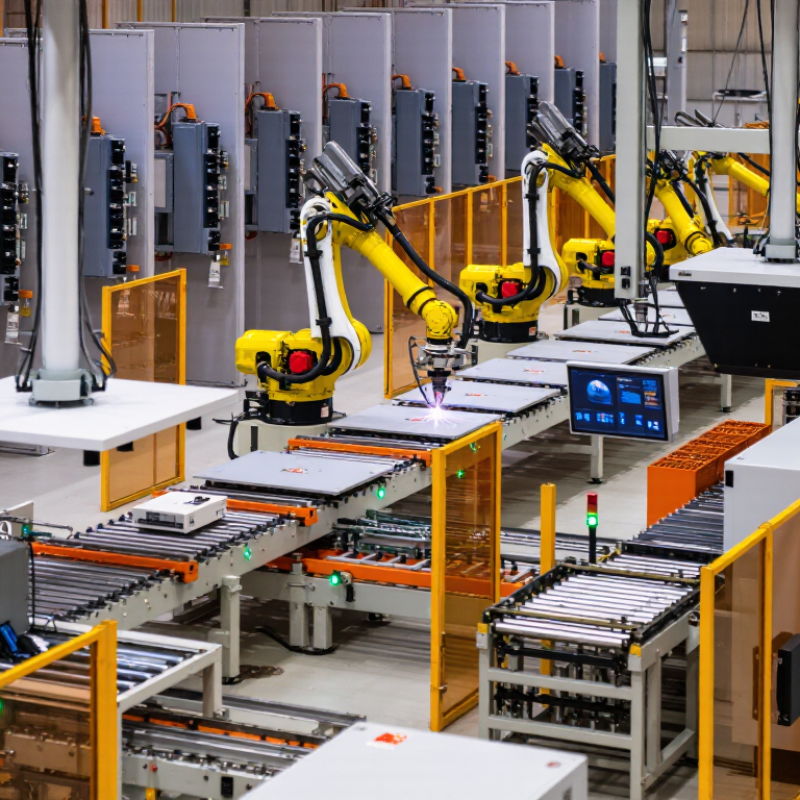
Industrial automation equipment includes the hardware and software used to monitor, control, and improve industrial operations. Its scope begins with sensors that measure temperature, pressure, position, or vibration. It extends to programmable controllers, human-machine interfaces, motor drives, robots, safety systems, and supervisory software. These components support discrete manufacturing, process industries, logistics, utilities, and mixed production lines. The equipment is not merely mechanical. It forms a connected control architecture.
Core technologies include real-time control, feedback loops, motion control, machine vision, and industrial communication networks. Edge devices can process data near the machine, reducing delays and unnecessary cloud traffic. Industrial Ethernet and field networks help controllers exchange reliable information. Cybersecurity is also essential because connected equipment increases operational exposure. A sound design uses clear data ownership, access control, backup procedures, and tested failure responses. In practice, integration is often harder than purchasing equipment. A technically advanced system can still perform poorly when sensors are misplaced or operators receive confusing alarms. That deserves reflection.
Tips: Define the production problem before selecting equipment. Check environmental ratings, response time, maintenance access, and spare-part availability. Test the complete control sequence with realistic signals. Small commissioning errors become expensive later. Avoid assuming that more automation always means better performance. Human judgment still matters.
Global Market Structure and Criteria for Comparing Leading Manufacturers
Top Industrial Automation Equipment Manufacturers Worldwide
The global market is structured around controllers, industrial robots, drives, sensors, machine vision, and software. These categories increasingly overlap. A robot supplier may also provide motion control, safety systems, and production analytics.
The International Federation of Robotics reported 541,302 industrial robots were installed worldwide in 2023. The operational stock exceeded 4.28 million units.
These figures show scale, but scale alone cannot identify the strongest manufacturer. Buyers should compare regional service coverage, spare-part availability, integration expertise, and average repair time.
Small details matter. A delayed encoder can stop an entire line.
Technology depth requires closer testing. Interoperability with existing PLCs, fieldbus systems, cloud platforms, and safety networks should be verified before purchase. The World Robotics 2024 report also indicates major differences in robot adoption between manufacturing regions. Therefore, a supplier’s local engineering capacity can matter more than its global sales volume.
Energy performance deserves attention too, especially for high-cycle motors and compressed-air systems. Data from the International Energy Agency links industrial efficiency gains with better motor systems and digital control, although equipment-level savings vary widely.
Price comparisons often remain incomplete. Installation, programming, training, cybersecurity updates, and five-year maintenance costs should enter the calculation. No ranking is perfect.
I would also question vendor claims based only on laboratory demonstrations. Factory acceptance tests, documented uptime, and customer references provide stronger evidence.
Some manufacturers publish limited failure data, which makes comparison difficult. That uncertainty should be recorded, not ignored.
Regional Strengths and Industry Applications of Major Manufacturers
Regional strengths shape how industrial automation equipment is designed, tested, and installed. East Asian manufacturers often excel in compact motion systems, factory robots, and high-speed assembly equipment. Their products suit electronics, battery, and precision machining plants. European manufacturers are widely respected for modular control platforms, machine safety, and energy-efficient production lines. These strengths support automotive, food processing, and pharmaceutical applications.
North American manufacturers commonly focus on flexible software, industrial networking, and process integration. Their systems work well in warehouses, oil and gas facilities, and large distribution centers. German-speaking regions often emphasize mechanical durability and standardized engineering practices. Nordic suppliers tend to develop efficient solutions for clean production and harsh environments. Regional expertise matters during commissioning. Local service teams can reduce downtime when a sensor fails at midnight.
Still, regional labels can mislead. A strong robotic arm may perform poorly without suitable tooling, training, and maintenance planning. I have seen projects lose weeks because cable routing was treated as an afterthought. Small details matter. Dust, heat, vibration, and unstable network signals can change the result. Buyers should compare lifecycle cost, spare-part access, software compatibility, and technician response time. Factory tests provide useful evidence, but site conditions reveal more. Even experienced teams sometimes underestimate operator feedback. That mistake deserves review before expansion.
Top Industrial Automation Equipment Manufacturers Worldwide: Regional Strengths and Industry Applications
Asia represented approximately 73% of global industrial robot installations in 2022, followed by Europe at about 15% and the Americas at about 12%, according to International Federation of Robotics reporting. Asian automation demand is strongly associated with electronics, electrical equipment and automotive production; Europe has particular strength in automotive, machinery and process industries; and the Americas show significant adoption in automotive, food and beverage, logistics and general manufacturing.
Innovation Trends Shaping the Future of Industrial Automation Equipment
Industrial automation is shifting from isolated machines to connected production systems.
The International Federation of Robotics reported 541,302 industrial robots installed worldwide in 2023. More than 4.28 million robots were operating globally. That installed base raises a practical question: can factories become adaptable, not merely faster?
Current innovation centers on edge computing, machine vision, digital twins, and AI-assisted maintenance. Data now moves beside the machine. Deloitte’s 2024 Smart Manufacturing and Operations Survey found that 86% of executives expect smart manufacturing to drive competitiveness within five years. Yet adoption remains uneven. Small details matter. Sensor drift, poor network design, and incomplete maintenance records can weaken an otherwise impressive system.
The World Economic Forum’s Global Lighthouse Network reports show how advanced analytics and automation can improve productivity while supporting resource efficiency. In practice, this requires more than installing robots. Engineers must connect older equipment, protect operational technology, and train operators to question algorithmic recommendations. A digital twin may predict a bearing failure, but technicians still verify vibration, temperature, and sound. That human check is not outdated. It is often the safest layer. Energy-aware scheduling is also gaining attention, especially where compressed air, motors, and heating systems dominate factory consumption. The uncomfortable truth is that many automation pilots still measure speed better than resilience, energy use, or worker usability.