Why Are Aftermarket RC Parts Better Than Stock Parts?

Stock RC parts are built to work across many drivers, surfaces, and budgets. That makes them dependable starting points, but not perfect choices for every build. A stock plastic suspension arm may flex during hard landings. A basic servo may feel slow when steering through tight turns. Small differences become obvious on the track.

Aftermarket Rc Parts can offer stronger materials, tighter tolerances, or settings better suited to a specific driving style. Veteran RC racer and designer Mark Pavidis is a respected industry voice. The following line is an editorial paraphrase, not a verified direct quote: “A worthwhile upgrade should improve performance without making the car harder to maintain.” That distinction matters. A shiny aluminum part is not automatically better than a well-designed stock component.

Good upgrades solve clear problems. Check fit, weight, durability, and replacement availability before buying. Compare the part with your vehicle’s manual, and inspect mounting points for cracks or wear. A metal upgrade might resist impact, yet transfer more force to nearby components. That trade-off is easy to miss. Track conditions matter, too. Loose dirt, carpet, and pavement place different demands on tires and suspension. Start with one change, then test the car in familiar conditions. Keep notes on handling, temperatures, and wear. Sometimes the stock part is still the smarter choice. The goal is not to replace everything; it is to build a more predictable RC car, one informed decision at a time.
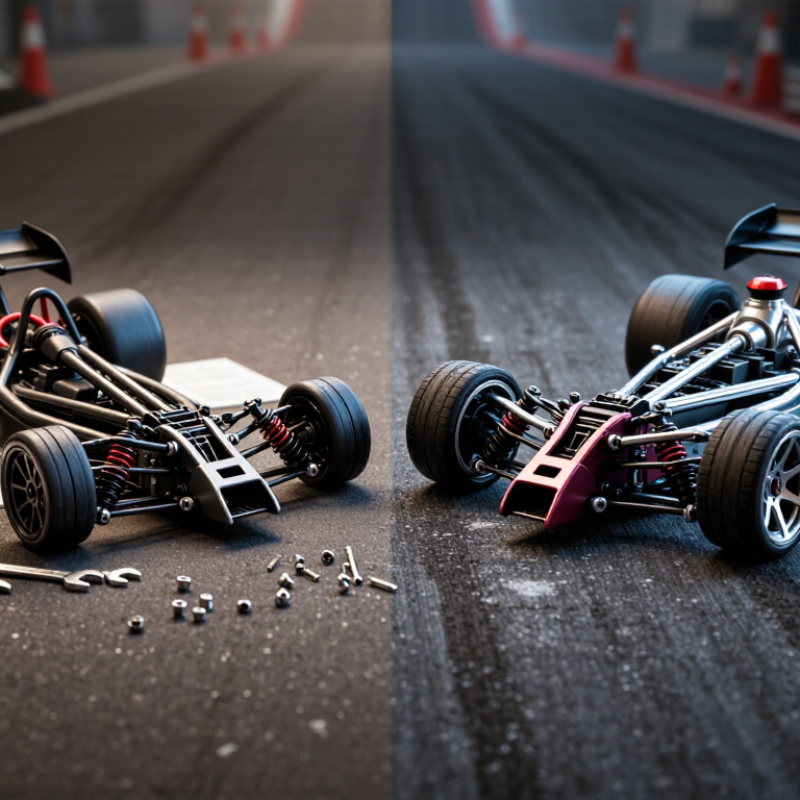
Why Are Aftermarket RC Parts Better Than Stock Parts?

What Stock and Aftermarket RC Parts Mean

Stock RC parts are the components supplied with a vehicle or specified as its original replacements. They are designed around the model’s intended dimensions and setup. Aftermarket parts are made by independent manufacturers, not the vehicle’s original supplier. The term describes where a part comes from, not whether it is better. That distinction matters. Some aftermarket components closely match stock pieces; others change material, shape, weight, or adjustment range.

For example, a stock suspension arm may use flexible plastic to absorb small impacts. An aftermarket arm might be stiffer, lighter, or simply made to different dimensions. Those changes can affect handling and durability, but the result depends on the vehicle and how it is driven. “Aftermarket” is not a quality guarantee. It is tempting to assume an upgrade must perform better. That assumption can be wrong. Before choosing a part, compare its measurements, mounting points, material, and stated compatibility with your RC model. Even a small fit difference can cause rubbing or loose screws. Keep the original part nearby while checking; it is a useful reference, though not a perfect guide to every replacement.

How Aftermarket Parts Differ in Materials and Design

Aftermarket RC parts can differ from stock parts in both material and geometry. Some use aluminum, steel, or reinforced composites where stock components use molded plastic. Metal may resist bending around suspension mounts, but it can transfer impact force to nearby parts. That trade-off matters. A harder part is not automatically a better part.

Design changes can affect fit, weight, cooling, and service access. For example, a revised shock tower may add bracing near mounting holes, while a vented mount may improve airflow. Tighter tolerances can reduce unwanted play, yet make installation less forgiving. Check hole spacing, screw length, and clearance at full steering lock before running. Even a small mismatch can cause rubbing or stripped threads. I would not assume every upgrade improves handling; extra weight can make a small vehicle feel sluggish.

Tips: Compare material and dimensions with the original part before buying. Look for smooth edges, clean holes, and consistent thickness. After installation, move the suspension by hand and check for binding. Recheck screws after the first short run. It is easy to miss one. Keep the stock piece nearby until the new part proves reliable. Some changes work beautifully; some are just shiny.

Why Aftermarket RC Parts Can Differ from Stock Parts

Representative tensile strength of materials sometimes used in RC components

Reinforced polymers and aluminum can provide higher tensile strength than unfilled nylon, which may help a part resist deformation under load. Aftermarket designs may also change geometry or reinforcement, but stronger does not always mean better: weight, impact behavior, fit, and cost matter. These are representative material values—not a universal stock-versus-aftermarket comparison; actual results vary by grade, manufacturing process, and part design.

Which Performance Improvements Can Upgrades Offer?

Aftermarket upgrades can make an RC car feel more controlled, not merely faster. A brushless motor and matching electronic speed controller can deliver smoother acceleration and reduce brush wear. Motor efficiency depends on load, gearing, and cooling, so a larger motor alone may add heat rather than useful speed. The U.S. Department of Energy’s 2023 Motor Systems Market Data report emphasizes that motor performance depends on the whole drive system, not the motor in isolation. That lesson applies here. Check motor temperature after a short run.

Suspension and tire upgrades improve how power reaches the ground. Oil-filled shocks can keep the chassis steadier over repeated bumps, while softer tires may grip better on loose dirt. The trade-off is real: extra grip can increase motor load, and stiff springs can make a light RC car bounce across rough pavement. The U.S. Department of Energy’s Vehicle Technologies Office notes that rolling resistance affects energy use in road vehicles; the same basic friction principle helps explain why tire choice changes runtime and handling, though RC results vary by surface and scale. A data point is not a guarantee. Record lap times, battery voltage, and motor temperature before and after each change, then adjust gearing or shock settings one step at a time.

How Compatibility, Cost, and Reliability Shape Upgrade Choices

Aftermarket RC parts can improve fit, strength, or adjustability, but only when they match the vehicle. Check mounting points, shaft diameter, gear pitch, battery voltage, and connector type before ordering. A motor that fits the chassis may still draw more current than the speed controller can handle. Stock parts often offer predictable fit; upgrades trade that certainty for choice.

Cost needs the same careful check. Include adapters, tools, shipping, and the possibility of replacing a mismatched part. SEMA’s 2023 Market Report estimated U.S. specialty-equipment sales at $52.3 billion in 2022. That figure covers automotive products, not RC parts, so it cannot prove upgrades are more reliable.

There is no universal RC failure-rate figure that makes aftermarket parts an automatic win. Compare material, fit, warranty terms, and replacement availability instead. A metal component may resist impact, yet transfer more force to nearby parts. Easy to miss.

It is tempting to judge reliability by weight or price alone; neither tells the whole story. Inspect screws and joints after early runs, especially if the vehicle feels hotter or noisier than before.

When Stock Parts May Be the Better Option

Aftermarket RC parts may offer tougher materials or adjustable geometry, but stock parts can be the better choice when reliable fit matters most. An original suspension arm matches the chassis mounting points and intended geometry, so installation is usually straightforward. Fit matters. If the vehicle is otherwise unmodified, a stock replacement can avoid extra adjustments to steering or suspension. It may also make troubleshooting easier: fewer changed variables mean fewer places to look when handling feels wrong.

Circana’s 2023 U.S. toy-industry report recorded $28.3 billion in sales, down 8% from 2022; unit sales fell 7%, while average prices declined 1%. This broad market report does not measure RC repair choices, so it cannot prove stock parts are cheaper or more durable. Still, it offers useful context for shoppers watching costs. Replacing a broken arm with the matching stock part may be sensible when damage came from one hard impact, not repeated failures. Check nearby components, too. A bent hinge pin can make a new arm seem defective. It is easy to blame the plastic before checking. When a stock part has failed repeatedly under ordinary use, an aftermarket upgrade may be worth considering—but confirm fit and material claims before buying.

Why Are Aftermarket RC Parts Better Than Stock Parts? — When Stock Parts May Be the Better Option

Comparison Factor Aftermarket Parts Stock Parts When Stock May Be Better
Choice and customization Often available in more materials, colors, designs, and performance specifications. Usually limited to the original design and the available replacement options. Choose stock when you want the vehicle to remain close to its original setup.
Strength and durability Some upgraded parts use tougher materials or reinforced designs, but quality varies by manufacturer and part. Designed for the vehicle’s original operating conditions; durability is generally predictable in normal use. Stock is a sensible choice for routine driving when the original part has performed reliably.
Fit and installation Fit may be direct, but some parts can require adjustments, compatible hardware, or setup changes. Typically designed to match the vehicle’s original dimensions and mounting points. Choose stock when you need a straightforward repair or want to avoid compatibility uncertainty.
Performance and handling May improve a specific characteristic, such as steering response, suspension tuning, or heat management. Preserves the original balance and behavior of the vehicle. Stock may be preferable if you value familiar handling or do not want to retune related components.
Cost Prices range from economical replacements to premium upgrades; extra parts or setup may add to the total. Pricing varies by part and seller; a direct replacement can help avoid additional modification costs. Compare the complete installed cost, especially for small repairs or vehicles used casually.
Availability Can provide alternatives when an original-style part is difficult to find, though availability depends on the vehicle and part. May be easy to source for current or widely supported models, but older parts can be harder to locate. Use whichever option is available, correctly specified, and supported by clear compatibility information.
Warranty and support Coverage and technical support depend on the individual seller or manufacturer; check the terms before buying. May be covered by the vehicle’s original parts or service policies, depending on age and purchase source. Stock may be preferable when maintaining applicable warranty coverage is a priority; verify the specific terms.
Best suited for Owners seeking a particular upgrade, customization, or replacement alternative and willing to verify fit. Owners prioritizing original behavior, predictable fit, and a simple replacement. For either option, confirm the part number, vehicle version, dimensions, and intended use before ordering.

Part quality, fit, price, and performance vary by vehicle, component, and supplier. Check compatibility and product specifications before purchase.

×
img

    Contact Info

    PHONE NUMBER

    +1 (619) 661-5985

    EMAIL ADDRESS

    sale@roboticemotion.com

    ADDRESS INFO

    10030 Via de la Amistad San Diego CA 92154, United States