Choosing an Automatic Bag Feeding Machine can shape an entire packaging line’s reliability. The right model should feed bags smoothly, protect product quality, and reduce repetitive operator work. In real factories, small mismatches often create large delays. A bag that bends near the opening can stop a line within minutes. That detail is easy to overlook. This guide introduces seven practical tips for making a more dependable choice.
Begin with bag dimensions, materials, thickness, and opening style. Paper, woven polypropylene, laminated film, and pre-opened bags behave differently. Confirm the machine’s usable range with physical samples, not only a brochure. A controlled test should measure feeding accuracy, changeover time, dust control, and reject handling. Ask for data from applications similar to yours. Supplier experience matters. Still, marketing claims require careful verification. Review service response, spare-part availability, operator training, guarding, and integration with upstream and downstream equipment.
The best selection also considers total cost over years, not just purchase price. Energy use, maintenance access, downtime, and future format changes can alter the calculation. Reliable manufacturers explain limitations clearly and document performance conditions. That honesty is valuable. One imperfect trial should not be hidden; it should reveal what needs adjustment. By comparing evidence, machine fit, and daily usability, buyers can choose equipment with greater confidence. The following seven tips turn that evaluation into a clear, practical process.
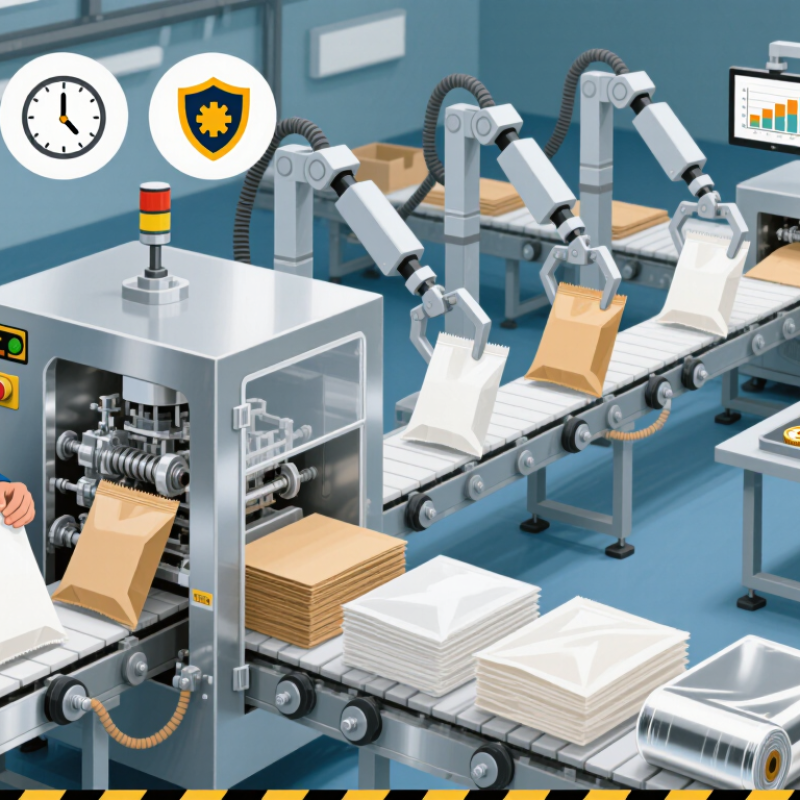
Define bag compatibility before comparing machine speed. Measure bag length, width, gusset depth, and opening position. Include manufacturing tolerances, not only nominal dimensions. A 2-millimeter variation can cause skewed feeding or double picks. Confirm the feeder’s adjustment range against the largest and smallest bags.
Material changes feeding behavior. Smooth films may slide, while paper or laminated structures can create friction and static. Check the bag’s coefficient of friction, stiffness, and surface treatment. The bag weight also matters. Lightweight pouches may flutter under air pressure, while heavy bags can overload vacuum cups. In plant trials, mixed bag batches often expose problems that samples hide. That part is easy to underestimate.
The Flexible Packaging Association’s 2024 State of Flexible Packaging report valued U.S. flexible-packaging sales at about $39.8 billion in 2023. Such volume reflects many formats, not one universal feeding solution. Ask suppliers to test your actual bags, including recycled-content films and printed surfaces. For sealing, use ASTM F88/F88M methods to measure seal strength and establish an acceptable range. The feeder should protect the seal area and maintain consistent presentation. A narrow tolerance may improve accuracy, but it can reduce flexibility during production changes. I would not approve a machine from a single successful run. Three shifts, different operators, and controlled humidity provide better evidence. Even then, some uncertainty remains.
An automatic bag feeding machine should match real line demand, not its maximum speed. A stated range of 30–120 bags per minute sounds attractive, but product changeovers, film alignment, refilling, and minor stoppages reduce usable output. If your packing line needs 75 bags per minute, a machine rated at 80 may operate too close to its limit. A 100–120 bag-per-minute model gives operators breathing room and supports future demand.
Use measured production data before choosing capacity. Record hourly output, downtime, rejected bags, and changeover minutes for several shifts. Then compare the machine’s practical rate with line demand. For example, 60 bags per minute equals 3,600 bags per hour before losses. At an estimated 85% operating efficiency, usable output falls to about 3,060 bags per hour. That difference matters.
Industry investment also supports careful automation planning. The International Federation of Robotics reported 541,302 industrial robots installed worldwide in 2023, showing continued automation growth. PMMI’s recent packaging-industry outlook highlights labor availability and flexible production as important investment drivers. However, faster is not always better. Excess speed can increase misfeeds, seal defects, and product damage. I have seen specifications look perfect on paper, then struggle with soft or uneven bags. Request a timed trial using your actual bag sizes, materials, and filling schedule. Leave room for learning. Production reality is rarely as clean as the brochure.
Compare rated machine capacity with actual line demand. The effective output uses an 85% operating-efficiency assumption to account for loading, changeovers, minor stops, and routine adjustments.
Choose a machine whose effective output is above the required line demand, while leaving enough capacity for normal production variation and future growth.
7 Tips for Choosing an Automatic Bag Feeding Machine
Verify Reliability: Target ≥99.5% Pick Accuracy and <1% Misfeed Rate
Choosing an automatic bag feeding machine starts with measurable performance, not attractive specifications. A dependable unit should achieve at least 99.5% pick accuracy and below 1% misfeeds during realistic production trials. That threshold matters. Ask for test records, sample sizes, and operating conditions before making a decision.
Request a factory acceptance test using your actual bag materials, dimensions, weights, and stacking patterns. Run enough cycles to reveal occasional errors, not just a short demonstration. Record every missed pick, double pick, skewed bag, and empty cycle. A spreadsheet with timestamps can expose patterns that a polished presentation may hide. Different humidity levels may also affect flexible packaging.
Inspect the machine’s sensors, grippers, vacuum system, and adjustment points. Operators should correct common issues without complex tools or long delays. Ask how accuracy changes after dust buildup, bag deformation, or a brief air-pressure drop. I have found that maintenance access often matters more than impressive speed claims. A perfect number on a sales sheet is not proof. Independent verification is better, although it can add time and cost. Also check whether performance reports explain failures honestly. Machines rarely perform identically across every bag type, so plan a small safety margin above the minimum target.
| Tip | Evaluation Dimension | Recommended Acceptance Target | How to Verify | Warning Signs | Reliability Status |
|---|---|---|---|---|---|
| 1 | Pick Accuracy | At least 99.5% successful single-bag picks | Run a controlled trial of at least 2,000 consecutive cycles using the actual bag material, dimensions, and stacking condition. Record successful picks divided by total cycles. | Accuracy is measured only during short demonstrations, or the supplier excludes difficult bags and restart cycles. | Pass: ≥99.5% |
| 2 | Misfeed Rate | Less than 1.0% misfeeds, including double picks, missed picks, skewed bags, and incorrect orientation | Count every misfeed during the same production-representative trial. Require a written definition of misfeed before testing so results cannot be interpreted selectively. | Double picks are recorded as acceptable output, or operators manually correct faults without logging them. | Pass: <1.0% |
| 3 | Throughput Stability | Maintain the required line speed for at least 30 minutes without performance degradation or repeated stoppages | Test at the intended bags-per-minute rate with a full-size production batch. Record actual output, micro-stops, jams, and operator interventions. | Rated speed is achieved only with empty magazines, ideal bag conditions, or frequent manual assistance. | Pass: Stable Output |
| 4 | Bag Compatibility | Reliable operation across the complete approved range of bag length, width, thickness, material, and surface finish | Use samples representing the thinnest, thickest, smallest, largest, most flexible, and most static-prone bags expected in production. Test each configuration separately. | Performance depends on one ideal bag type, or the supplier cannot provide adjustment limits and changeover settings. | Pass: Range Verified |
| 5 | Changeover and Setup | Repeatable changeover with documented settings and no-tool or low-tool adjustments where practical | Measure the time from the last good bag of one format to the first good bag of the next format. Repeat the changeover at least three times and compare results. | Changeover requires undocumented trial and error, extensive sensor repositioning, or highly experienced operators. | Pass: Repeatable |
| 6 | Fault Detection and Recovery | Detect empty pick, double pick, bag jam, low magazine level, and abnormal position; provide clear alarms and safe recovery | Intentionally simulate each fault condition. Verify that the machine stops or rejects safely, displays a clear message, and resumes without producing unidentified defective output. | Faults are detected only after downstream equipment stops, or the machine resumes with bags missing from the process. | Pass: Faults Logged |
| 7 | Maintenance and Traceability | Accessible wear parts, documented preventive-maintenance intervals, cycle counters, and stored fault history | Review the maintenance manual, spare-parts list, lubrication requirements, sensor life expectations, and alarm records. Confirm that operators can retrieve basic production and fault data. | No maintenance schedule, unclear critical spares, inaccessible components, or no method for identifying recurring faults. | Pass: Documented |
When choosing an automatic bag feeding machine, inspect integration before counting speed. The PLC should exchange clear signals with your line controller, while servo control maintains accurate bag spacing. During commissioning, technicians should verify every input and output beside the machine. A loose sensor cable can create expensive downtime.
Sensors need practical placement, not impressive specifications. Check bag detection, empty-stack alarms, jam detection, and guarding feedback. Confirm whether signals use 24 VDC interfaces, common reference points, and documented wiring labels. The IFR World Robotics 2024 report recorded 541,302 industrial robot installations worldwide in 2023. This growth increases the need for reliable communication between feeding equipment and automated cells.
Ask for cycle-time evidence using your actual bag material. Film stiffness, static electricity, and uneven stacks can change performance. Servo tuning may work well during factory testing, then struggle on a humid production floor. That happens. A controlled dry-run cannot replace site trials. Deloitte’s 2024 Smart Manufacturing and Operations Survey found that 86% of manufacturers expect smart manufacturing to become essential for competitiveness within three years. Choose a machine with accessible diagnostics, backup parameters, and simple fault messages. Fancy integration is not always useful. A clear 24 VDC diagram may save more time than another speed claim.
Choosing an automatic bag feeding machine requires more than checking speed and capacity. Safety and hygiene should guide the review. An IP65 rating protects the enclosure against dust and water jets. It does not prove that the machine is hygienically designed. That distinction matters.
ISO 12100 supports a structured risk assessment. Ask whether operators can reach moving parts, loading areas, or sealing mechanisms. Guards, interlocks, emergency stops, and clear instructions should work together.
IEC 60204-1 covers the machine’s electrical equipment and control systems. Check wiring protection, grounding, control panels, and restart behavior after power loss. Small details matter.
FDA rules may apply when bags or machine surfaces contact food, medicine, or other regulated materials. FDA compliance is not a single approval stamp for the whole machine. Request material declarations, traceability records, cleaning procedures, and supplier test reports. Confirm that lubricants and surface materials suit the intended process.
I once treated a neat certificate folder as proof of good hygiene. That was too optimistic. Inspect corners, welds, drains, and powder buildup around moving parts. Avoid deep ledges and exposed threads. Cleaning should be practical, not merely promised. A qualified safety professional can verify the risk assessment and local requirements before purchase. Documentation can be incomplete. Review it critically.
+1 (619) 661-5985
sale@roboticemotion.com
10030 Via de la Amistad San Diego CA 92154, United States
We can supply pre-cut pipes and roller tracks, with the appropriate number of joints and accessories; delivered in kit form as per your specifications.