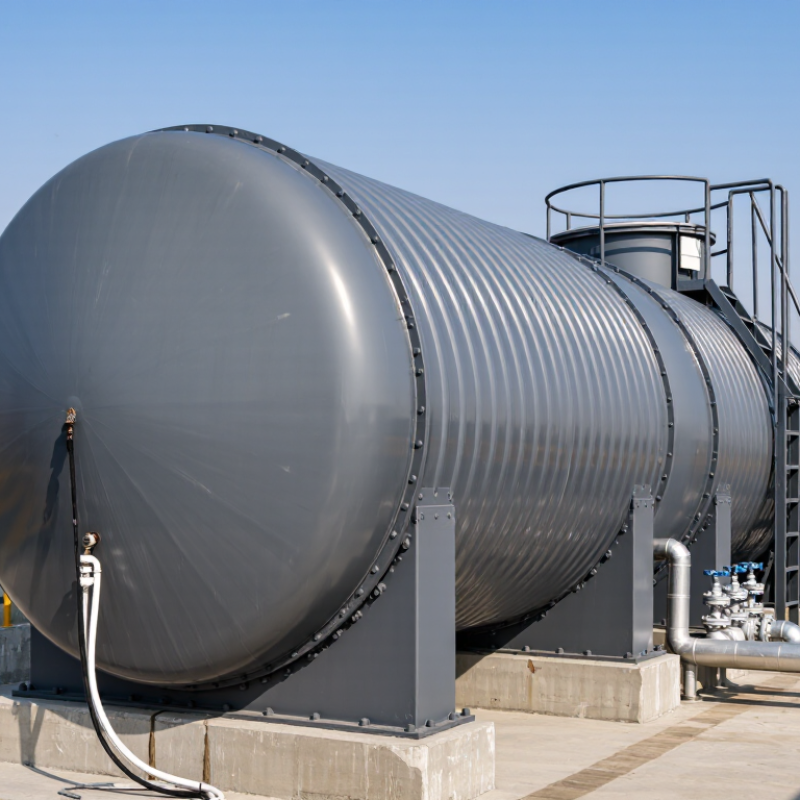
Choosing an Atex Water Tank for a global project involves more than selecting volume and steel thickness. The tank must fit the site’s explosion-risk assessment, water duty, climate, and maintenance capability. ATEX concerns equipment used in potentially explosive atmospheres. It does not automatically certify every tank installed near hazardous materials.
The need for reliable water infrastructure is substantial. The WHO and UNICEF Joint Monitoring Programme reported in 2023 that 2.2 billion people lacked safely managed drinking water in 2022. Industrial projects face additional pressure. Their tanks may support process water, emergency firefighting, or potable supplies under demanding conditions. A practical design must consider ATEX zone classification, vapor exposure, static control, grounding, temperature range, corrosion, access, and inspection records. European Commission guidance on Directive 2014/34/EU remains a key reference for equipment intended for explosive atmospheres. EN 1127-1 also provides recognized principles for preventing and protecting against explosions.
Details matter. A tank beside a solvent area may require different controls from one serving a remote mine. A dark external coating can raise water temperature. Poorly bonded fittings can create avoidable static risks. A tank marketed as “ATEX-ready” may still lack project-specific evidence. That assumption is often wrong.
This guide explains how to compare materials, certifications, protective systems, and suppliers. It also considers ISO, EN, AWWA, and local fire-water requirements. Experienced engineers should verify every claim against the hazardous-area dossier and operating conditions. Global projects rarely fail because of tank capacity alone. They fail when documentation, installation, or maintenance is overlooked.
An ATEX water tank is not simply a tank painted for hazardous areas. It is a water storage system designed for use near a potentially explosive atmosphere. ATEX refers to European requirements for equipment used where gases, vapours, mists, or combustible dust may ignite. The tank shell may be non-electrical and low risk. However, its level sensor, pump, heater, mixer, cable gland, or control panel can become an ignition source. This distinction matters. A tank does not automatically need ATEX certification because it stores water.
It is typically required when the tank or connected equipment sits inside a classified zone, such as a solvent plant, fuel terminal, gas-processing site, chemical workshop, or dust-producing facility. The zone classification, gas or dust group, temperature class, ambient conditions, and equipment category should guide selection. Project engineers should review the explosion protection document and confirm requirements with the competent site authority. For global projects, local regulations may add conditions beyond ATEX. Treating an ATEX label as universal approval can create expensive gaps.
Tips: Map every component before ordering. Check the sensor, pump, wiring, earthing, and maintenance access. Ask for certificates, technical files, and installation limits. Stainless steel, coatings, and seals must also suit the stored water and environment. In practice, teams sometimes focus on the tank body and overlook a small non-compliant switch. That mistake is easy to make. A second review is worthwhile.
How to Choose an ATEX Water Tank for Global Projects?
Water is not usually the ignition source. The surrounding atmosphere determines the explosion-protection requirement. Start with the site’s hazardous-zone classification. For gases and vapours, Zone 0 means continuous danger, Zone 1 means likely danger during normal operation, and Zone 2 means unlikely or short-term danger. Combustible dust uses Zones 20, 21, and 22. These definitions follow IEC 60079-10-1 and the European ATEX framework.
Check the process conditions around the tank, not only inside it. Review nearby solvents, vapour release points, dust layers, ventilation, temperature, and pressure. Electrical level sensors, pumps, switches, cable glands, and inspection lights may require suitable Ex certification. Bonding and earthing also matter, because static discharge can ignite a flammable atmosphere. The ILO’s 2023 global estimates reported about 2.93 million work-related deaths annually. That figure is not explosion-specific, but it shows why weak assumptions deserve attention. A zone drawing can still be incomplete.
Tips: Ask the process engineer for the hazardous-area classification and gas or dust group. Match every electrical component to the required equipment category, protection level, temperature class, and ambient range. Confirm tank materials, fittings, and access points with the site risk assessment. Keep certification records traceable across countries. I have seen projects focus on the tank shell while overlooking one cable gland. That small gap can delay approval. Local interpretation may also differ, so independent review remains sensible.
The chart shows the minimum ATEX equipment category generally required for equipment installed in each hazardous area. A higher protection index indicates a stricter protection requirement: Category 1 provides the highest level, followed by Category 2 and Category 3.
Gas zones: Zone 0 requires Category 1G, Zone 1 requires at least Category 2G, and Zone 2 requires at least Category 3G. Dust zones: Zone 20 requires Category 1D, Zone 21 requires at least Category 2D, and Zone 22 requires at least Category 3D. Final selection should also consider the tank’s location, flammable medium, temperature class, dust group, pressure, and applicable local regulations.
Choosing an ATEX water tank for a global project requires more than checking volume and price. Start with the site’s hazardous-area classification, operating temperature, water chemistry, and installation environment. ATEX requirements may apply to electrical or mechanical components near the tank, not always to the tank shell itself. Confirm this distinction with a qualified safety engineer and the local authority.
Material selection should match the water and surrounding conditions. Stainless steel can suit hygienic applications, while reinforced polymer tanks may reduce corrosion risks. Check ultraviolet exposure, freeze protection, pressure limits, and cleaning methods.
Capacity should cover daily demand, emergency reserves, refill delays, and future expansion. A practical calculation should include peak consumption, not only the average figure. I have seen projects underestimate fire-water storage because seasonal demand was ignored. That mistake becomes expensive after installation.
Tips: Request zone drawings, material certificates, weld records, inspection documents, and component conformity evidence before ordering. Specify grounded conductive parts where required, suitable vents, level monitoring, overflow protection, and safe access points. Keep electrical devices outside hazardous zones whenever possible. Review every sensor and control panel separately. Small details matter. Global projects also need clear maintenance instructions, multilingual warning labels, and spare-part planning. Do not assume one design fits every country; local standards and site conditions may change the final specification.
How to Choose an ATEX Water Tank for Global Projects?
An ATEX water tank should match the site’s explosion-risk assessment, not just a sales specification. Confirm the zone, gas or dust group, temperature class, and required equipment category. The tank may be passive, while pumps, sensors, mixers, and control panels can create ignition risks. Check each component separately. A certificate alone can mislead.
Request the EU Declaration of Conformity and the complete technical file index. Review approved drawings, material grades, weld procedures, inspection records, and surface-finish details. For electrical parts, verify marking, protection method, temperature class, and ambient limits. For non-electrical parts, ask how possible friction, static electricity, and hot surfaces were assessed. Earthing points should be visible and identified on the drawings.
Project documentation must remain traceable after delivery. Serial numbers, inspection reports, operating limits, maintenance instructions, and spare-part details should match the installed tank. If pressure applies, confirm whether separate pressure-equipment requirements affect the design. Global projects also need translated manuals and local installation records. Do not accept copied certificates.
Small gaps matter.
In project reviews, teams sometimes verify the certificate but overlook the final configuration. That is a practical weakness. A modified nozzle, different instrument, or longer cable can change compliance. Compare the delivered tank with the certified design before commissioning. Record deviations honestly, even when the schedule is tight. A clear document trail supports safer decisions and easier audits.
| Verification Dimension | What to Check | Applicable Requirement or Standard | Typical Evidence or Project Document | Example Acceptance Criteria | Priority |
|---|---|---|---|---|---|
| 1. Hazardous-Area Classification | Confirm whether the tank will be installed in an area containing flammable gas, vapour, mist, or combustible dust. | Area classification according to IEC 60079-10-1 for explosive gas atmospheres or IEC 60079-10-2 for explosive dust atmospheres. | Hazardous-area classification drawing, zoning study, process safety document, and client area schedule. | The project identifies the applicable zone, gas or dust group, temperature class, and equipment protection level before equipment selection. | Mandatory |
| 2. ATEX Applicability to the Tank | Determine whether the water tank is an ATEX product or a non-electrical item installed inside an ATEX zone. | EU Directive 2014/34/EU applies to equipment and protective systems intended for potentially explosive atmospheres. A passive tank is not automatically an ATEX-certified product. | ATEX applicability assessment, equipment boundary document, and written classification decision by the responsible engineering party. | The assessment clearly separates the tank shell from associated instruments, pumps, mixers, valves, heaters, vents, and electrical accessories. | Mandatory |
| 3. Zone and Equipment Category Matching | Check that each ATEX-relevant component has a protection level suitable for the installation zone. | Typical gas-zone relationship: Zone 0 requires Category 1G or EPL Ga; Zone 1 requires Category 1G or 2G or EPL Ga/Gb; Zone 2 requires Category 1G, 2G, or 3G or EPL Ga/Gb/Gc. Dust zones use 1D, 2D, and 3D or EPL Da, Db, and Dc. | Equipment schedule, ATEX marking records, EU-type examination certificates where applicable, and manufacturer declarations. | The selected equipment category or EPL is equal to or higher than the minimum level required by the zone assessment. | Mandatory |
| 4. Equipment Group and Temperature Class | Verify the gas or dust group and maximum surface-temperature limitation for every electrical or mechanical item. | Common gas groups include IIA, IIB, and IIC. Common gas temperature classes are T1 to T6, with T6 having the lowest maximum surface temperature. Dust equipment uses maximum surface temperature and dust-group requirements. | ATEX marking schedule, equipment datasheets, certificate annexes, and hazardous-area equipment register. | The equipment marking is compatible with the identified gas or dust group and does not exceed the process or ignition-temperature limits. | Mandatory |
| 5. Tank Construction and Pressure Boundary | Confirm design pressure, vacuum conditions, operating temperature, material compatibility, corrosion allowance, weld quality, and relief requirements. | For pressure equipment placed on the EU market, Directive 2014/68/EU may apply when the maximum allowable pressure exceeds 0.5 bar. EN 13445 may be used for unfired pressure vessels where specified by the project. | Design calculation, pressure and vacuum rating, material certificates, welding procedure specification, welder qualifications, and inspection plan. | The tank is suitable for the specified operating and design conditions, including filling, draining, thermal expansion, pump-out, and blocked-vent scenarios. | Mandatory |
| 6. Static Electricity and Bonding | Evaluate electrostatic charge generation on the tank, lining, pipework, hoses, filters, and connected equipment. | IEC 60079-0 and IEC TS 60079-32-1 provide relevant principles for electrostatic hazards associated with equipment and installations in explosive atmospheres. | Earthing and bonding drawing, resistance test record, material data for non-metallic parts, and installation inspection checklist. | All conductive parts are bonded and earthed as specified; insulating materials are assessed for charge accumulation and permitted use. | Mandatory where applicable |
| 7. Electrical and Instrumentation Accessories | Check level switches, temperature sensors, pressure transmitters, solenoid valves, junction boxes, cable glands, pumps, motors, and control panels. | IEC 60079 series and the applicable national adoption of ATEX or another accepted conformity system. Associated intrinsically safe circuits must be assessed as a complete system. | Equipment certificates, declarations of conformity, control drawings, intrinsic-safety loop diagrams, cable schedules, and installation manuals. | Every device has traceable marking, an appropriate certificate or declaration, suitable ingress protection, and installation instructions for the designated zone. | Mandatory where applicable |
| 8. Non-Electrical Ignition Sources | Review bearings, rotating agitators, friction points, hot surfaces, mechanical seals, impact points, and possible adiabatic compression. | EN ISO 80079-36 and EN ISO 80079-37 address non-electrical equipment and protection concepts for explosive atmospheres. | Non-electrical ignition-risk assessment, mechanical equipment technical file, temperature assessment, and maintenance instructions. | Potential ignition sources are identified, controlled, and documented; operating limits and maintenance intervals are defined. | Mandatory where applicable |
| 9. Venting, Drainage, and Process Interfaces | Verify vent routing, overflow protection, drain arrangement, flame or pressure protection where required, and separation from incompatible fluids. | Project process design basis, hazardous-area study, applicable pressure-equipment rules, and local fire and environmental requirements. | Piping and instrumentation diagram, line list, vent calculation, relief-device datasheet, drainage plan, and cause-and-effect matrix. | Vents and drains do not create an uncontrolled release or new hazardous zone; discharge locations and isolation arrangements are defined. | Mandatory |
| 10. Certification Route for Global Projects | Identify whether the destination accepts ATEX, IECEx, local certification, or a combination of schemes. | ATEX is an EU legal framework. IECEx is an international conformity-assessment system, but acceptance depends on the destination country and project specifications. | Regulatory compliance matrix, country requirements register, certificate acceptance statement, and client approval record. | The selected certification route is accepted by the authority having jurisdiction, end user, insurer, and procurement specification. | Mandatory |
| 11. Declaration and Marking Review | Check the legal manufacturer information, product designation, applicable directives, standards, certificate number, marking, and year of manufacture. | EU Declaration of Conformity requirements under the applicable EU legislation; ATEX marking must be consistent with the certified equipment configuration. | EU Declaration of Conformity, certificate copy, product label photograph, nameplate drawing, and certificate schedule. | The nameplate and documents identify the same model, protection concept, category, group, temperature class, and permitted conditions of use. | Mandatory where ATEX applies |
| 12. Quality and Manufacturing Records | Confirm traceability of pressure parts, welds, coatings, gaskets, fasteners, and safety-critical components. | Project quality plan, inspection and test plan, specified material standards, and applicable pressure-equipment or fabrication requirements. | Material certificates, weld maps, non-destructive examination reports, dimensional inspection report, coating records, and final release note. | Critical materials and fabrication activities are traceable to the approved drawings, purchase specifications, and inspection points. | Mandatory |
| 13. Factory Acceptance Testing | Verify tank dimensions, nozzles, fittings, instruments, alarms, interlocks, leakage performance, and documentation before shipment. | Approved inspection and test plan and project-specific factory acceptance test procedure. | FAT protocol, signed test results, calibration certificates, punch list, final inspection release, and photographic records. | All specified functional tests pass, deviations are closed or formally accepted, and calibration is valid at the time of testing. | Mandatory |
| 14. Installation and Commissioning | Check foundation, anchoring, pipe stress, earthing, cable glands, equipment orientation, protective devices, and correct installation in the classified area. | IEC 60079-14 for electrical installations in explosive atmospheres, together with local installation and construction requirements. | Installation inspection report, commissioning procedure, electrical continuity test, insulation test, loop-check records, and as-built drawings. | Installation matches certified conditions and approved drawings; all safety-critical tests are completed before energization or operation. | Mandatory where applicable |
| 15. Inspection, Maintenance, and Repair | Define periodic inspection, cleaning, corrosion monitoring, instrument calibration, bonding checks, and repair controls. | IEC 60079-17 for inspection and maintenance of electrical installations in explosive atmospheres; manufacturer instructions and local workplace rules also apply. | Operations and maintenance manual, inspection schedule, spare-parts list, repair procedure, training records, and maintenance log. | Maintenance tasks preserve the certified configuration and include controls against unauthorized component substitution. | Mandatory where applicable |
| 16. Final Project Documentation Package | Ensure the complete technical file is available in the required language and format for approval, operation, and future audits. | Applicable ATEX, pressure-equipment, electrical, workplace-safety, environmental, and local statutory requirements. | Approved drawings, calculations, certificates, declarations, manuals, risk assessments, test records, spare-parts data, and as-built dossier. | No open documentation gaps remain for certification, installation, commissioning, operation, maintenance, or authority inspection. | Mandatory |
Choosing an ATEX water tank starts with the site, not the catalogue. Confirm the hazardous-zone classification, stored-water purpose, temperature range, and local approval route. ATEX requirements may apply to pumps, level sensors, mixers, and electrical accessories rather than the tank shell alone. Ask each supplier for zone compatibility, material certificates, weld records, pressure or leak-test results, and a clear technical file. A vague compliance statement is not enough. It creates trouble during inspection.
Compare suppliers by evidence, installation support, and response time. Request drawings showing foundations, access clearances, earthing points, overflow routes, and safe drainage. Global projects often face uneven ground, restricted cranes, heat, salt air, or freezing nights. A supplier should explain how the tank arrives, how panels are lifted, and who checks bolt torque and seals. Obtain local contractor requirements in writing. Small gaps become expensive.
Long-term maintenance deserves equal weight. Check inspection intervals for coatings, gaskets, ladders, vents, earthing continuity, and connected instruments. Ask whether replacement seals and sensors remain available after installation. Keep photographs, test certificates, cleaning records, and repair history in one controlled file. Maintenance teams need practical access, not only a polished drawing. One common mistake is accepting a perfect first proposal without challenging assumptions about water quality or sediment. Revisit them after the first operating season. Site conditions rarely behave exactly as predicted.
+1 (619) 661-5985
sale@roboticemotion.com
10030 Via de la Amistad San Diego CA 92154, United States
We can supply pre-cut pipes and roller tracks, with the appropriate number of joints and accessories; delivered in kit form as per your specifications.