7 Tips for Choosing a Closed Granulation Line

A Closed Granulation Line can influence product consistency, operator exposure, cleaning effort, and production efficiency. Choosing one is not simply a matter of comparing equipment capacity or price. The line must suit the material, process, facility, and intended batch scale. The wrong configuration can create avoidable transfer steps, difficult cleanouts, or bottlenecks between operations. Details matter.

Before comparing suppliers, define the process requirements. Consider powder characteristics, target batch size, granulation method, drying needs, and downstream handling. These details help determine whether the proposed system can manage the material reliably from charging through discharge. Ask how containment is maintained at connection points, where dust may escape, and how operators can inspect or clean product-contact areas. Practical answers are more useful than broad claims.

A sealed system may reduce open handling, but it does not automatically guarantee easy cleaning or consistent results. Not every line fits. This article presents seven practical tips for evaluating equipment layout, process integration, controls, cleaning access, documentation, supplier support, and future capacity. It also highlights questions worth asking during technical discussions and factory reviews. Specifications deserve careful checking, and assumptions should be challenged when they are unclear. A thoughtful selection process can help teams identify a line that fits real operating conditions—not just a brochure.
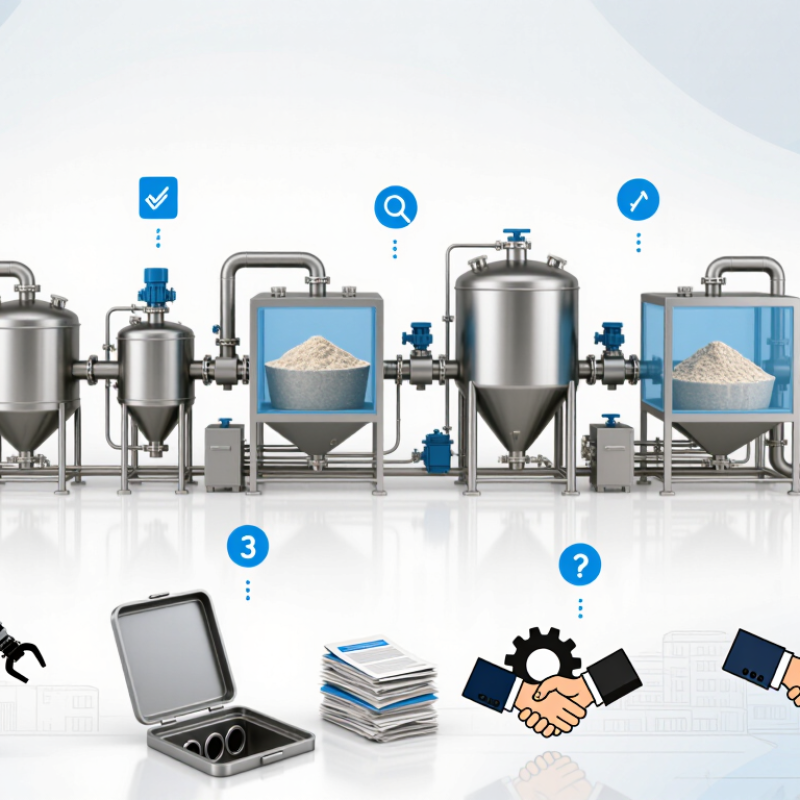
7 Tips for Choosing a Closed Granulation Line

Assess Product Properties and Granulation Requirements

Choosing a closed granulation line starts with the powder, not the equipment. Measure particle-size distribution, bulk density, moisture sensitivity, and flow before comparing mixers, granulators, dryers, or mills. USP General Chapter 1174 describes four powder-flow approaches: angle of repose, compressibility index, orifice flow, and shear-cell testing. Use more than one. A cohesive fine powder may bridge in a hopper, while a dense blend may segregate during transfer. Small details matter. Check binder viscosity, liquid addition rate, target granule size, and whether heat or shear could damage the product. An aqueous process may suit one formulation and fail with another.

Translate those properties into requirements for granule size, residual moisture, throughput, containment, and cleaning. FDA’s 2011 Process Validation guidance defines three lifecycle stages: process design, process qualification, and continued process verification. Build sampling points into the line. During trials, record torque, product temperature, liquid feed, and drying endpoint; these readings help distinguish a verified endpoint from a granule that merely looks right. Pilot batches can reveal awkward transitions, such as sticky material clinging to a wall or dry fines escaping extraction. One uncomfortable truth: lab flow tests do not perfectly predict full-scale behavior. Verify the scale-up with product-specific trials.

Define Containment and Operator Safety Needs

Containment planning should begin with the powder, not the equipment brochure. Review its dustiness, batch size, transfer steps, and exposure data with qualified safety and process personnel. A fine powder can escape during charging, discharge, or a poorly sealed connection. Small leaks matter.

Map every point where an operator opens or connects the line. Check feed ports, valves, sampling points, and the discharge into downstream equipment. Ask how containment performance will be verified with the actual material and operating conditions. A drawing may look sealed, yet routine sampling can create an overlooked exposure path. Test the details.

Operator safety also depends on daily tasks. Can staff inspect seals without awkward reaching? Are pinch points guarded, and are cleaning and maintenance steps clearly defined? Consider suitable local extraction, safe access platforms, and clear isolation procedures. Closed does not mean risk-free. No layout is perfect; maintenance access can compete with containment, and that trade-off deserves a real review. Include operators in the design discussion, then document what must be checked before each run.

7 Tips for Choosing a Closed Granulation Line: Define Containment and Operator Safety Needs

Example planning priorities for evaluating a closed granulation line. Rate each item against your process, materials, and site-specific risk assessment; scores are illustrative, not universal requirements.

How to use this chart: Define powder-handling and exposure-control needs first, then confirm transfer, cleaning, dust-hazard, ergonomic, and monitoring requirements with qualified safety and process specialists.

Compare Equipment Design and Process Integration

7 Tips for Choosing a Closed Granulation Line
Compare Equipment Design and Process Integration

A closed granulation line is more than a sealed mixer. Its transfer points, filters, controls, and cleaning access determine how well equipment works as one process. The 2019 Deloitte–MAPI Smart Factory Study found that 86% of surveyed manufacturing executives expected smart-factory solutions to drive competitiveness within five years. That broad industry finding supports careful attention to connected controls, though it is not specific to granulation.

Tip 1: Map every material transfer. Tip 2: Check seals and dust extraction. Tip 3: Compare mixer and mill geometry. Tip 4: Review cleaning access. Tip 5: Confirm control-system compatibility. Tip 6: Test alarms and data handoffs. Tip 7: Ask for an integrated process trial. Small details matter.

Compare equipment using the same product and operating assumptions. Check whether granule size, moisture, and throughput can be measured at meaningful points, not only at the line’s end. FDA’s Process Validation guidance (2011) frames validation as a lifecycle activity, reinforcing the need to consider design, routine operation, and ongoing monitoring together. Request interface drawings and a clear account of how recipes, alarms, and batch records pass between units. A neat layout can still hide awkward cleaning steps. I would challenge that assumption during a site review. These choices can affect changeover time and process consistency, but results depend on the formulation and operating conditions.

7 Tips for Choosing a Closed Granulation Line - Compare Equipment Design and Process Integration

Tip Equipment Design to Compare Process Integration Considerations What to Verify
1. Define the containment objective Compare sealed transfer connections, enclosure design, dust extraction interfaces, and provisions for safe disconnection. A closed configuration can reduce operator exposure, but it does not by itself guarantee a particular containment level. Map every powder-transfer step, including charging, discharge, sampling, and equipment changeover, to identify where the process could be exposed to the room. Ask for containment test methods and results for the intended material and operating conditions. Confirm how routine interventions and maintenance are handled.
2. Match the granulation method to the formulation Compare high-shear wet granulation, fluid-bed granulation, and dry granulation designs. They differ in mixing action, liquid addition, drying needs, and suitability for different material properties. Check how the chosen method connects to dispensing, drying, milling, and final blending, and whether the process flow supports the intended batch sequence. Review development or scale-up data for the formulation, including granule properties, yield, and the effects of process variables such as liquid addition and mixing time.
3. Compare transfer and connection design Assess sealed product paths, transfer containers or valves, docking arrangements, and the number of manual handling steps between equipment items. Confirm that connection sizes, elevations, discharge points, and transfer routes align with upstream and downstream equipment. Request a process-flow diagram and equipment layout. Check for trapped product, difficult-to-access connections, and practical ways to verify correct docking.
4. Evaluate cleaning and changeover Compare clean-in-place capability, removable product-contact parts, drainability, access for inspection, and the design of seals and dead spaces. Determine whether cleaning utilities, wash steps, drying, and inspection can be coordinated across the full line rather than equipment by equipment. Review cleaning procedures and validation approach for the actual product-contact surfaces. Confirm how cleaning status is documented before the next batch.
5. Check utilities and environmental controls Compare requirements for electrical power, compressed air, process air, vacuum, water, and exhaust. For fluid-bed systems, airflow and filtration are especially important design considerations. Verify that facility capacity, utility quality, room conditions, and exhaust arrangements support simultaneous operation of connected equipment. Request a utility load list and identify temperature, humidity, pressure, and filtration requirements. Confirm how filter inspection and replacement are managed.
6. Assess automation and data handling Compare recipe control, sensor coverage, alarms, interlocks, and the ability to control and record critical process parameters. Check whether equipment controls can exchange the necessary batch, status, and alarm information with the facility control system and adjacent process steps. Review the control-system boundary, data records, user access, and alarm handling. Confirm that recorded parameters match the process-control strategy.
7. Plan capacity, flexibility, and lifecycle support Compare working-volume range, allowable batch sizes, change parts, wear components, maintenance access, and the ability to accommodate future formulations. Assess bottlenecks across the entire line, including transfer, drying, cleaning, and material staging—not just the nominal capacity of the granulator. Use representative batch-cycle estimates and maintenance plans. Verify spare-part availability, operator training needs, and access for inspection and servicing.

Evaluate Capacity, Automation, and Utility Requirements

A closed granulation line should fit the product and the production schedule, not just a target output on a brochure. Estimate kilograms per hour using the actual formulation, bulk density, and moisture range. Include feeding, granulation, drying, milling, and transfer time; a fast granulator cannot compensate for a slow dryer. Numbers can mislead. Leave practical headroom for recipe changes, cleaning, and unexpected stops, but avoid buying capacity that sits idle most shifts.

Assess automation against the work operators really perform. Automated feeding, process monitoring, and alarms can reduce repetitive checks, but only if sensors are accessible and readings are useful. Ask operators to walk through a normal shift, including startup, sampling, and cleaning. Small details matter. A touchscreen does not replace clear procedures or training. Consider how the line records batch parameters and how quickly staff can identify a blockage. Full automation may look efficient on paper; its maintenance demands deserve equal attention.

List utility needs before finalizing the layout: electrical load, compressed air, water, exhaust, drainage, and temperature control. Confirm peak demand, not only average consumption, with the facility team. Check where pipes and cables must cross walkways or cleaning zones. A utility estimate can still be wrong if it ignores simultaneous equipment use. Recheck assumptions against the building’s available capacity and the actual production area, including space for service access.

Review Cleaning, Validation, and Supplier Support

A closed granulation line can limit dust release, but enclosed equipment is not automatically easy to clean. Powder may collect around valve seats, gasket grooves, and transfer elbows. Ask how operators reach these areas and whether product-contact parts can be removed without special tools. A smooth-looking surface is not enough. That detail matters.

Cleaning procedures should match the materials, product characteristics, and equipment design. During validation, document the cleaning steps, rinse or swab locations, and the reasoning behind each sampling point. A sample from an accessible flat surface may miss residue trapped behind a seal. Set acceptance criteria with qualified quality staff, and keep records that another operator can follow. Some procedures look tidy on paper but prove awkward on a busy shift.

Supplier support deserves the same scrutiny as the equipment itself. Request clear drawings, material compatibility information, maintenance instructions, and practical operator training. Ask who helps when a seal wears early or a cleaning result falls outside its limit. Response times matter. So does continuity. Confirm how updates to software, components, or procedures are communicated, and whether replacement parts remain available. A short trial with your actual cleaning routine can reveal gaps that a polished demonstration will not.

×
img

    Contact Info

    PHONE NUMBER

    +1 (619) 661-5985

    EMAIL ADDRESS

    sale@roboticemotion.com

    ADDRESS INFO

    10030 Via de la Amistad San Diego CA 92154, United States