Buying a Hydraulic Forging Press is a major production decision, not just a search for the highest tonnage. A press that looks right on a specification sheet may still struggle with your actual die size, stroke, or production rhythm. The consequences show up on the shop floor: uneven parts, long changeovers, excess heat, or an idle line awaiting service. Small details matter.
Energy deserves attention, too. The International Energy Agency’s Energy Efficiency 2023 report estimates that industry accounts for roughly 37% of global final energy consumption. That figure is not specific to forging presses, but it underscores why buyers should compare motor power, hydraulic system efficiency, cooling needs, and expected operating hours. A lower purchase price can be misleading if the machine runs continuously.
Demand conditions also vary by region and end market. The World Steel Association’s Short Range Outlook reports track changing steel demand, a useful reminder that forecasts and production plans can shift. Seven practical buying tips can help global buyers assess press capacity, frame design, control systems, safety features, installation requirements, supplier support, and lifecycle costs. And, honestly, buyers sometimes focus too heavily on headline force. A careful review should also ask whether the supplier can provide documented performance data, clear maintenance guidance, and realistic spare-parts lead times. Those questions are less exciting, but they prevent expensive surprises.
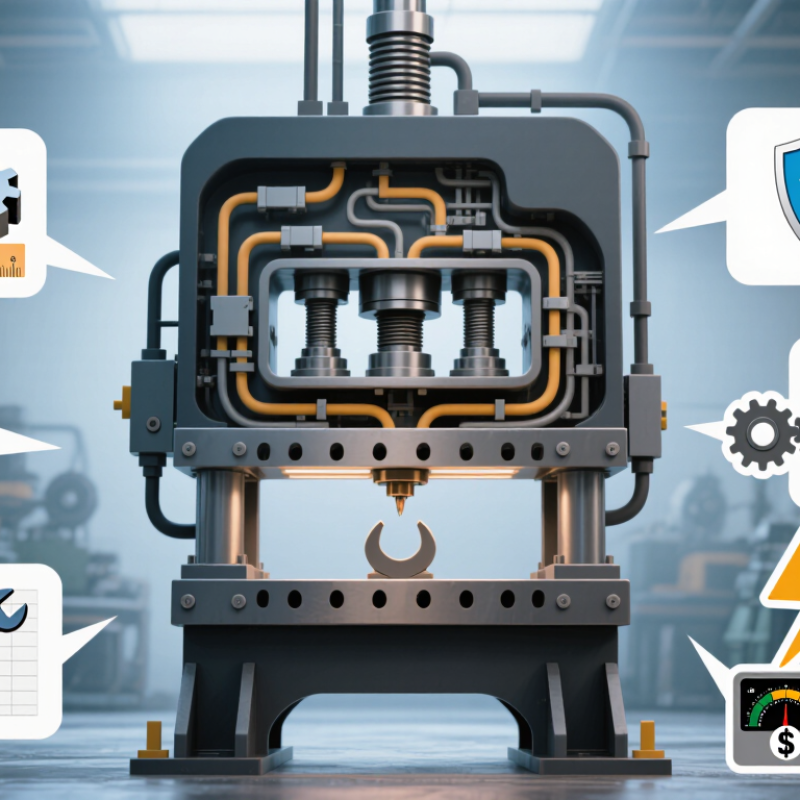
Define the part before comparing press tonnage. Record the alloy, billet dimensions, target temperature, die layout, and finished-part tolerances. These details shape forming load and stroke requirements. Measure the largest part, too. A press sized only for average jobs may struggle with occasional large forgings.
Scale and material demand matter, but they are not sizing formulas. worldsteel’s World Steel in Figures 2024 reports 1,888.2 million tonnes of crude steel production in 2023. That figure signals the scale of the metal supply chain, not the force your press needs. For each part family, ask a forging engineer to estimate load using material strength at working temperature, contact area, and process stages. Small batches matter. They may not justify the same automation or die-change speed as continuous production.
Check the shop floor against the production plan. Note available daylight, bed size, foundation limits, and operator access around the dies. Compare required strokes per minute with actual cycle time, including loading and inspection. A spreadsheet can hide awkward changeovers. I would leave room for future parts, but not pay for capacity without a likely use. Recheck assumptions against trial data; calculated loads can miss friction, temperature loss, or uneven billet placement.
| Buying Tip | Requirement to Define | Information to Collect | Why It Matters |
|---|---|---|---|
| 1. Define the part and process | Part geometry, forging method, and process stages | Part drawings, CAD files, material grade, billet dimensions, and whether the process is open-die, closed-die, or another forming operation | Press selection depends on the workpiece, tooling, and forming process—not tonnage alone. |
| 2. Establish material and temperature conditions | Workpiece material and forming temperature range | Alloy or steel grade, hot or cold forming, billet temperature at pressing, and expected temperature variation | Material strength and temperature affect deformation resistance, tooling, and the required press force. |
| 3. Size the force for the actual operation | Required forming force, with an engineering margin | Projected contact area, material and temperature data, die design, process sequence, and force estimates from a qualified process engineer | A suitable rated capacity should be confirmed against the load profile and the machine’s permitted operating conditions. |
| 4. Check stroke, daylight, and bed space | Working envelope for the part, dies, and handling equipment | Required stroke, maximum open height, shut height, bolster dimensions, die height, and access for loading and removal | Adequate force does not guarantee that the tooling and workpiece will fit or can be handled safely. |
| 5. Set output and duty-cycle targets | Required parts per shift and operating schedule | Target good parts per hour, shifts per day, changeover frequency, expected cycle time, and planned maintenance downtime | Production targets help determine whether cycle speed, automation, and the planned duty cycle are appropriate. |
| 6. Specify control and process monitoring | Required control functions and production records | Pressure or force control, ram position settings, recipe storage, alarms, data logging, and interfaces required by the plant | Clearly defined controls support repeatable operation and make process monitoring easier. |
| 7. Confirm site and safety requirements | Installation conditions, utilities, and safeguarding | Available floor space, foundation and floor loading, electrical supply, hydraulic system needs, guarding, operator access, and applicable local regulations | Early site checks can prevent installation delays and help ensure safe integration into the production line. |
Note: Final press capacity, machine configuration, and safety provisions should be validated by the equipment supplier and qualified process and safety professionals using the actual part, tooling, and site data.
A hydraulic forging press should be matched to the parts you actually make, not just the largest part on your drawing. Check the required forming force for your material, billet temperature, and die shape. A press rated at a certain capacity may not deliver that force throughout its full stroke, so review the machine’s force curve and operating conditions. Extra capacity can be useful, but an oversized press may add cost without improving the process.
Stroke matters when parts vary in height or require several forming steps. Compare the press travel with your die height, billet dimensions, and loading space. Leave room for safe handling and tool changes. Too little stroke can limit production; too much may slow each cycle. Measure your real setup. It is easy to overlook a small clearance issue on paper.
Operating speed also affects output and control. Fast approach and return speeds can shorten idle time, while a slower working speed may help maintain forming quality. Ask for speeds under load, not only maximum figures. If possible, test a representative part and record cycle time, pressure, and temperature. Numbers rarely tell the whole story. A first estimate may be wrong, and that deserves a second look.
When comparing hydraulic forging presses, inspect the safety system in operation, not only on paper. Ask how guards, interlocks, emergency stops, and pressure-relief devices respond during setup and production. The ram should not descend when a guard is open or a safety circuit is interrupted. Small details matter. Check that controls are clearly labeled and reachable without leaning near the die space. A light curtain can help, but only when its placement and stopping distance suit the machine’s actual cycle.
Review the control system’s fault detection, restart behavior, and protection against unexpected ram movement. Request wiring diagrams, safety-function documentation, and a demonstration of fault recovery. The U.S. Bureau of Labor Statistics’ 2023 Census of Fatal Occupational Injuries recorded 5,283 fatal work injuries across U.S. industries. This figure is not press-specific, but it underlines why safety controls deserve close review.
Check the applicable editions of ISO 16092-3 for hydraulic press safety, ISO 13849-1 for safety-related control systems, and IEC 60204-1 for machine electrical equipment. Requirements can vary by destination and installation, so confirm local adoption with a qualified safety professional. Ask for risk-assessment records and evidence that the supplied configuration matches them. A certificate alone may not reveal a poorly positioned sensor or an awkward maintenance procedure. That deserves a second look.
A hydraulic forging press is a long-term production asset, so evaluate the people behind it as carefully as its rated force. Ask suppliers for references from plants running comparable press capacities, materials, and duty cycles. Request commissioning records and examples of troubleshooting difficult pressure or temperature fluctuations. The 2024 True Cost of Downtime report estimated that downtime cost the world’s 500 largest companies about 11% of annual revenue. That broad, cross-industry figure is not a forging-press forecast, but it shows why service readiness deserves serious attention.
Set expectations before ordering. Ask who handles installation, operator training, and urgent technical calls, including time-zone coverage. Request realistic response targets in writing, then check whether service engineers can access hydraulic diagrams and control-system documentation. Ask for evidence. A polished presentation is not proof of field experience; speak with existing customers and ask how long faults took to diagnose.
Spare-parts support should be specific, not reassuringly vague. Obtain a recommended inventory for seals, filters, valves, sensors, and other wear-prone components, with part numbers and typical lead times. Confirm which items are stocked locally and which require overseas shipment. Ask how replacements are verified for compatibility and whether obsolete components have an approved substitute. A small seal can stop a large press. I would also check packaging and storage guidance; these details are easy to overlook, and sometimes the buyer does too.
A hydraulic forging press quote is only the starting figure. Compare the press price with crating, inland haulage, ocean freight, insurance, customs handling, unloading, and commissioning. Ask for packed dimensions and gross weight, not just machine dimensions. A wide frame may require a flat rack or other out-of-gauge handling. Get the assumed port, route, and delivery terms in writing.
Shipping schedules can shift. UNCTAD’s Review of Maritime Transport 2024 reported that weekly container-ship transits through the Suez Canal fell 67% by June 2024 from peak levels. That disruption is a useful reminder: request a valid quote period, likely surcharges, and a schedule buffer. Cheap freight can become expensive if storage or missed installation dates follow. A spreadsheet helps, but estimates are not guarantees.
Installation needs its own checklist. Confirm the site’s floor-loading capacity, foundation drawings, crane reach, doorway clearance, electrical supply, and hydraulic-oil requirements before shipment. Ask who provides riggers, electricians, levelling, and test materials. Request the press’s lifting points and installation sequence; a large frame cannot be improvised safely at the dock. I have seen purchase plans overlook floor access. That detail deserves a second look. Compare supplier estimates with local contractor quotes, and budget for commissioning travel, spare seals, and operator training.
+1 (619) 661-5985
sale@roboticemotion.com
10030 Via de la Amistad San Diego CA 92154, United States
We can supply pre-cut pipes and roller tracks, with the appropriate number of joints and accessories; delivered in kit form as per your specifications.