Choosing a Waterproof ATV Sound Bar requires more than comparing loudness and price. Real trail conditions expose weak designs quickly. Dust enters seams, branches strike housings, and sudden rain reaches exposed controls. A reliable model should match your riding environment, not just your garage setup.
Look for a clear IP rating, sealed speaker cones, corrosion-resistant hardware, and UV-resistant plastics. IP ratings matter. However, they do not guarantee unlimited protection. Always check the manufacturer’s testing details and warranty terms. A practical Waterproof ATV Sound Bar should deliver balanced sound without draining the battery too quickly. Check RMS power, amplifier efficiency, and automatic standby features. Loud specifications can appear impressive, but distortion becomes obvious above engine noise. Sound changes at speed.
Mounting also deserves careful attention. Measure your roll cage before ordering. Confirm the clamp diameter, cable length, and clearance around the steering controls. A secure bracket should resist vibration without crushing the tubing. Bluetooth range may decrease around metal frames or dense woodland. Wired controls can offer faster operation with muddy gloves, although they may require cleaner cable routing.
A weather-resistant remote, USB charging port, and replaceable fuse can improve daily convenience. Still, every feature adds another possible failure point. No checklist is perfect. Product pages often simplify real trail use. Read verified reviews describing rain, washing, vibration, and long rides. If possible, compare warranty support and installation instructions from established manufacturers. The best choice balances protection, sound quality, safe mounting, battery demand, and realistic maintenance. That balance matters more than a dramatic maximum-volume claim.
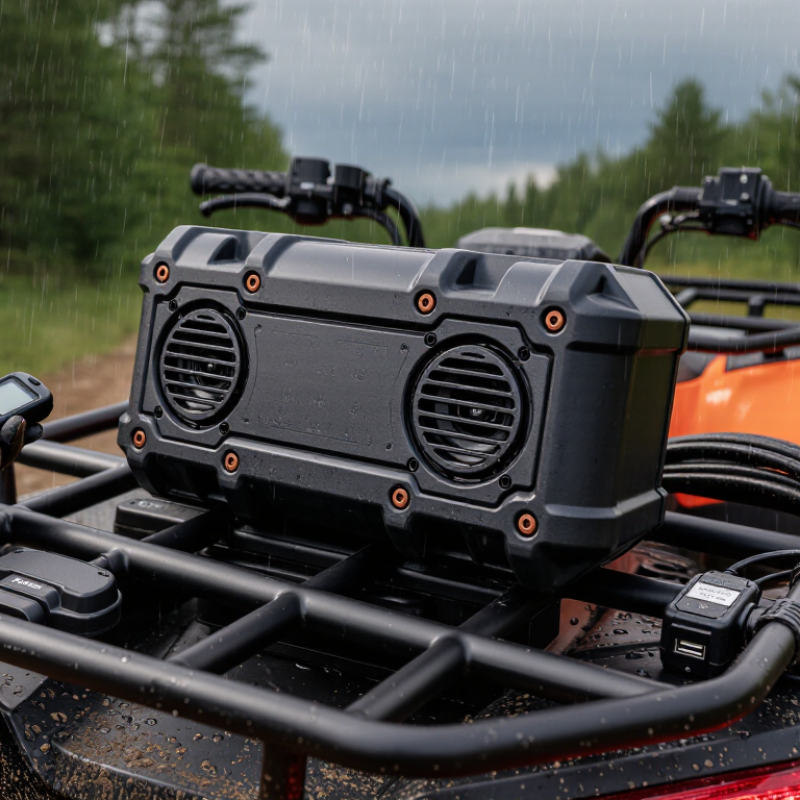
Water exposure is not a single problem. Mud, rain, pressure washing, condensation, and sunlight damage equipment differently. Before choosing an ATV sound bar, inspect your usual riding conditions. A humid forest trail needs different protection than a dry desert route.
The IEC 60529 standard defines IP protection levels. An IPX6 rating indicates resistance to powerful water jets. IPX7 indicates temporary immersion under controlled test conditions. However, these tests do not guarantee long-term performance after vibration, dust, or repeated temperature changes. That distinction matters. Field experience shows that water often enters through connectors, seams, and poorly protected controls. A sealed speaker grille can still have vulnerable wiring behind it.
Tips: Look for a documented IP rating, sealed connectors, corrosion-resistant fasteners, and UV-resistant housing. Ask whether testing covered salt spray and vibration. The National Oceanic and Atmospheric Administration reports that ultraviolet exposure increases with elevation, so mountain riders should take sunlight seriously. The Outdoor Industry Association’s 2024 participation report recorded 175.8 million outdoor recreation participants in the United States during 2023. More outdoor use means more repeated weather exposure, not just occasional rain.
Do not rely on the word “waterproof” alone. It can sound stronger than the test evidence. I would also check the warranty exclusions carefully. Some products survive a storm but fail after a season of washing and dust. That is an imperfect reality worth considering.
Your riding style should decide the sound bar’s power, speaker size, and sound quality. Trail riders often need clear vocals over engine noise, while open-field riders may prefer stronger bass and higher volume. Check RMS power instead of peak wattage. RMS reflects more realistic, continuous performance. Peak wattage can look impressive. It can also mislead.
Speaker size changes the listening experience. Smaller speakers fit tight dashboards and deliver focused sound. Larger speakers usually create fuller midrange and deeper bass, but they need more mounting space. Look for sealed construction, corrosion-resistant grilles, and a reliable water-resistance rating. Mud splashes, dust, and sudden rain can test every weak point. Bluetooth stability matters too, especially when the vehicle vibrates across rocky ground.
Tips: Match power to your engine noise, not your driveway volume. Test the unit with your helmet on. Adjust the music until voices remain clear without harsh treble. If you ride slowly through wooded trails, balanced sound may matter more than maximum output. If you ride fast across open land, extra headroom can prevent distortion. I would not choose the loudest model automatically. Excessive volume can hide warning sounds and become tiring during long rides. Also, remember that waterproof does not mean invincible. Poor installation, exposed wiring, or pressure washing can still cause damage. Leave room for airflow and secure every connector carefully.
How to Choose a Waterproof ATV Sound Bar?
A waterproof ATV sound bar should fit your vehicle before you consider its volume. Measure the roll cage diameter, mounting width, and available dashboard space. Universal clamps often fit several cage sizes, but “universal” does not mean effortless. I once found that a suitable clamp blocked the driver’s view of a control switch. That small mistake created unnecessary rewiring.
Check whether the sound bar supports your ATV’s voltage system and available battery capacity. Review its waterproof rating, connector protection, and cable length. A sealed housing helps, but exposed plugs can still cause trouble after muddy rides. Installation may require a fuse, relay, grounding point, and heat-resistant cable routing. Keep wires away from the exhaust, steering joints, and suspension movement. Leave enough slack for vibration, but not enough for branches to catch.
Tips: Test the mounting position before tightening every bolt. Turn the handlebars fully in both directions. Compress the suspension if possible. Confirm that the bar does not strike a helmet, cargo rack, or overhead branch. Use locking nuts and recheck them after the first ride. I prefer a quick sound test before final wiring, although this step is easy to overlook. Don’t trust appearance alone. A clean installation can still hide poor grounding or a weak clamp.
Compare the IEC 60529 ingress-protection levels before selecting a sound bar. Higher ratings indicate greater resistance to water exposure, but mounting fit, vehicle compatibility, and electrical installation requirements must also be checked separately.
Choosing a Waterproof ATV Sound Bar
An ATV sound bar should match your riding conditions, not only your preferred music volume. Bluetooth is convenient, but connection stability can change near trees, hills, or crowded riding areas. A wired input can provide a useful backup when wireless pairing fails. USB ports are helpful for charging, but check whether the port has a protective cover and suitable water resistance. Physical controls matter too. Large buttons are easier to use with dusty or gloved hands than a small touch panel.
Battery life deserves careful attention. Manufacturer estimates often assume moderate volume and mild temperatures. In real riding, loud playback, cold weather, and repeated pairing can reduce runtime. I once trusted a long battery claim and needed a recharge before the afternoon ride ended. A built-in battery suits removable installations, while a 12-volt power connection supports longer trips. Confirm the required voltage, fuse protection, cable length, and mounting clearance before installation. Poor cable routing can create vibration, water entry, or accidental damage.
Tips: Test every control while wearing your riding gloves. Pair your phone before leaving home. Keep a short charging cable in a sealed pouch. Check the charging cover after muddy rides. Do not rely on battery indicators alone; they can be imprecise. A sound bar may be advertised as waterproof, but its switches, ports, and wiring still need regular inspection.
How to Choose a Waterproof ATV Sound Bar?
Durability should begin with the IP rating, not the word “waterproof.” IEC 60529 rates IPX6 for powerful water jets and IPX7 for temporary immersion up to one meter. These tests do not guarantee protection from mud, vibration, or repeated pressure washing. Check for sealed connectors, corrosion-resistant hardware, and a grille that drains quickly. In practical installation work, loose brackets often fail before the speaker does. That detail is easy to overlook.
Tips: Confirm the test standard, not only the marketing label. Ask whether the IP test covered the complete installed unit. Inspect the mounting plate, cable exits, and fuse location before buying.
Safety certifications also affect value. Look for documented electrical testing under standards such as UL 62368-1, where applicable, and verify electromagnetic compliance for your region. A certification mark without a traceable certificate deserves caution. The World Health Organization’s 2022 Global Standard for Safe Listening recommends limiting exposure to 80 decibels for 40 hours weekly. Excessive volume can distract riders and mask approaching vehicles. A sound bar needs controlled output, not just louder output.
Warranty terms reveal practical confidence. Compare coverage length, exclusions for water damage, installation requirements, and replacement procedures. The U.S. Federal Trade Commission advises consumers to review written warranty terms before purchase. A cheaper unit may become expensive after one failed season. I still find total value difficult to judge because shipping, wiring, and replacement mounts are often ignored. Include every cost, including your time.
| Evaluation Dimension | Suggested Weight | Practical Benchmark | What to Verify Before Buying | Common Risk | Value Priority |
|---|---|---|---|---|---|
| Water Resistance | 25% | Choose at least IPX5 for protection against water jets. An IPX6 enclosure offers stronger protection against powerful water jets, while IPX7 is rated for temporary immersion in up to 1 meter of water for up to 30 minutes under laboratory conditions. | Check the complete IP code in the technical documentation. Confirm whether the rating applies to the entire sound bar, including control panels, cable exits, charging ports, and mounting accessories. | “Waterproof” may describe marketing performance rather than a tested enclosure. Saltwater, mud, pressure washing, and repeated vibration can exceed normal laboratory conditions. | High |
| Dust and Mud Protection | 10% | Look for the first IP digit, preferably 5 or 6. IP6X indicates a dust-tight enclosure, while IP5X indicates protection against dust that could interfere with operation. | Confirm that the manufacturer states both digits of the IP rating rather than only using a general “weather-resistant” claim. | Open speaker grilles, exposed switches, and poorly sealed cable glands can allow fine dust or mud into the enclosure. | High |
| Vibration and Impact Durability | 15% | Prefer a rigid enclosure, reinforced mounting points, corrosion-resistant fasteners, and a mounting system designed for off-road vibration. A published vibration or impact test is a positive sign. | Inspect the bracket material, fastener size, adjustment range, strain relief, grille attachment, and the availability of replacement mounting hardware. | A sound bar can remain electrically functional while its brackets loosen, the enclosure cracks, or internal components develop rattles. | High |
| Corrosion Resistance | 10% | For wet or coastal riding, choose sealed connectors and corrosion-resistant hardware such as stainless steel or treated aluminum. A documented salt-spray or corrosion test is preferable. | Check the materials used for brackets, screws, terminals, speaker grilles, and charging-port covers. Confirm whether the warranty excludes corrosion or salt exposure. | Surface corrosion may begin at fasteners and connectors even when the speaker enclosure still appears waterproof. | High |
| Electrical and Product Safety | 15% | For products sold in the United States, look for applicable electrical safety evaluation such as UL 62368-1 where relevant, plus radio compliance such as FCC Part 15. For other markets, verify the required local conformity marks. | Ask for certificate numbers, declarations of conformity, test reports, or certification-body details. A printed logo without traceable documentation should not be treated as proof. | Bluetooth functionality does not by itself prove electrical safety, electromagnetic compatibility, or legal radio compliance. | High |
| Power System and Wiring | 10% | Confirm that the voltage range matches the ATV electrical system, commonly a 12-volt accessory system. Look for an inline fuse, sealed connectors, polarity protection, and clear wiring instructions. | Review current draw, fuse rating, standby consumption, wire gauge, connector type, and whether the power cable is long enough for the intended installation. | Incorrect wiring, insufficient fusing, or undersized cables can cause intermittent operation, battery drain, or overheating. | High |
| Audio Performance | 8% | Compare measured output, frequency response, distortion, speaker configuration, and performance at the riding distance rather than relying only on peak wattage. | Give greater weight to continuous or RMS power, independent measurements, control usability, and clarity at higher volume levels. | Peak-watt figures can be much higher than continuous output and may not represent real-world loudness or sound quality. | Medium |
| Controls and Connectivity | 5% | Bluetooth should reconnect reliably, and controls should be usable with gloves. A wired input or secondary control method can be useful if wireless connectivity is interrupted. | Check Bluetooth range, pairing memory, button sealing, remote-control water resistance, microphone behavior, and compatibility with the intended phone. | Small unsealed buttons and poorly protected remotes can fail sooner than the main speaker enclosure. | Medium |
| Warranty and Support | 10% | Prefer a clearly written warranty of at least one year with defined coverage for electronics, speakers, controls, and mounting hardware. | Read exclusions for water damage, corrosion, commercial use, modification, incorrect installation, and pressure washing. Confirm claim procedures, proof-of-purchase requirements, and repair or replacement options. | A warranty may exclude the exact conditions that matter most for ATV use, including immersion, mud, saltwater, or vibration damage. | High |
| Total Cost of Ownership | 7% | Evaluate the purchase price together with installation hardware, wiring, fuse replacement, remote controls, replacement brackets, shipping, and possible service costs. | Confirm what is included in the package and whether replacement parts, technical support, and firmware updates are available. | A low initial price may become expensive if brackets, sealed cables, adapters, or replacement remotes must be purchased separately. | High |
| Decision rule: Prioritize verifiable IP testing, secure mounting, electrical protection, traceable safety documentation, and a warranty that explicitly addresses outdoor use. Treat unusually high wattage claims and unsupported “fully waterproof” statements as secondary evidence. | |||||
+1 (619) 661-5985
sale@roboticemotion.com
10030 Via de la Amistad San Diego CA 92154, United States
We can supply pre-cut pipes and roller tracks, with the appropriate number of joints and accessories; delivered in kit form as per your specifications.