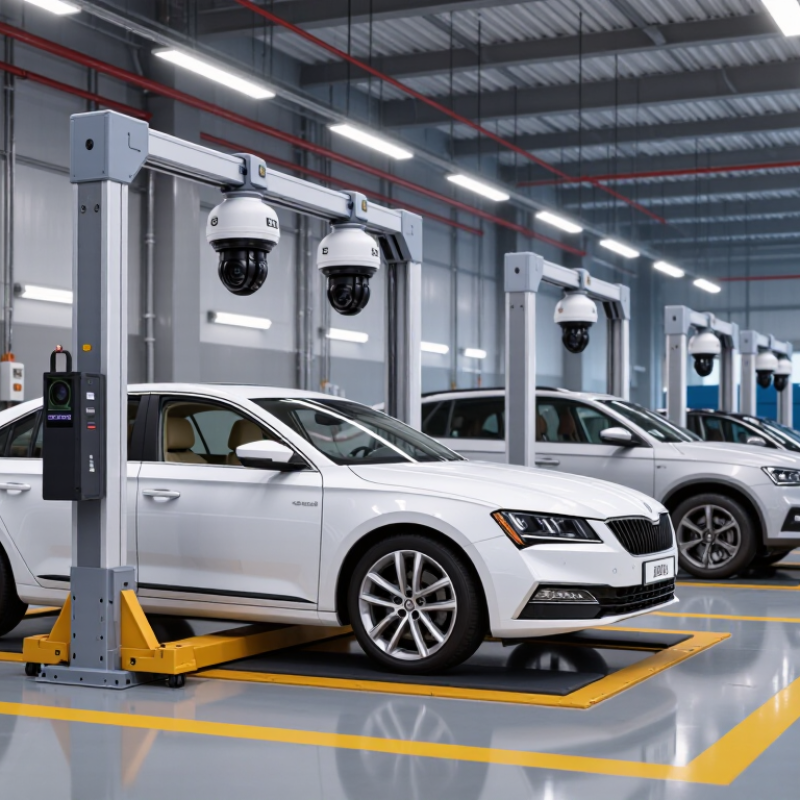
Vehicle inspections are changing as fleets, service centers, and transport operators handle more vehicles with less time. An Intelligent Vehicle Inspection System can help capture consistent images, flag visible defects, and organize inspection records. But its value depends on more than impressive demonstrations. A camera that misses a cracked lens, or software that struggles in a dim workshop, can create extra work instead of reducing it.
The right choice starts with real conditions. Consider the vehicles you inspect, the space available for equipment, and how staff will review alerts. Ask vendors to demonstrate common cases, such as worn tires, damaged body panels, and obstructed number plates. Check image quality, detection accuracy, reporting options, data protection practices, and compatibility with existing workflows. Request clear explanations of system limits, update requirements, and ongoing costs. That matters.
A careful evaluation should include the people who will use the system every day. Their feedback may reveal awkward steps that a sales presentation misses. Trial the equipment with different vehicle types and lighting conditions, then compare its findings with a qualified inspector’s assessment. No checklist removes every trade-off; some systems may be accurate yet difficult to maintain, while others may fit smoothly but offer fewer useful features. The following seven tips provide a practical framework for comparing options, asking better questions, and choosing a system that supports reliable inspections without promising more than it can deliver. Details matter.
Define coverage by what each OBD-II service mode can actually retrieve or command, not by a vague “full scan” label. SAE J1979 specifies ten modes:
Support varies by vehicle, model year, and protocol. A clear “not supported” message is better than a blank screen.
Check practical coverage at the vehicle, not just on a specification sheet.
S&P Global Mobility reported that the average age of U.S. light vehicles reached 12.6 years in 2024. That broad age range makes older protocols and mode-specific compatibility worth testing.
In a workshop, compare a cold-start Mode 01 reading with Mode 02 freeze-frame data after a fault; then verify that Mode 04 clearing does not hide Mode 0A permanent codes.
Small detail. Some tools display Mode 06 results without explaining monitor identifiers, leaving technicians to interpret raw values. That weakness deserves scrutiny.
Record supported modes by vehicle, flag unavailable functions, and test with real vehicles before setting coverage claims.
For an intelligent vehicle inspection system, define accuracy against the vehicle feature being measured, not a vague promise of “high precision.” Set tolerances for dimensions, gaps, or alignment from engineering requirements, then decide how much measurement error those tolerances allow. ISO/IEC 17025 requires competent testing and calibration, traceable measurements, and evaluation of uncertainty; it does not prescribe one universal accuracy limit. Ask the supplier for calibration records, uncertainty budgets, and results from repeat tests using the same vehicle and setup. Small details matter. A shifted camera mount or changing light can alter readings.
Repeatability should be tested across operators, shifts, and realistic bay conditions. The Automotive Industry Action Group’s Measurement Systems Analysis reference gives common screening guidance: gauge R&R below 10% of study variation is generally acceptable, 10–30% may be acceptable depending on risk, and above 30% is usually unsuitable. These are not automatic pass marks for every inspection task. Compare the results with your own tolerance and the cost of a missed defect. NIST’s Technical Note 1297 also provides a recognized method for expressing measurement uncertainty. Keep the raw readings, calibration status, and test conditions together. Real workshops are messy. One awkward point: a system can repeat the same wrong answer very consistently, so check accuracy against traceable reference artifacts, not repeatability alone.
When choosing an intelligent vehicle inspection system, check how it supports safety-related decisions. ISO 26262 defines four Automotive Safety Integrity Levels: ASIL A, B, C, and D. They reflect risk assessed through severity, exposure, and controllability, not simply the seriousness of a defect. ASIL D represents the highest integrity requirements; QM sits below the ASIL levels. Evidence matters.
Ask whether the system can detect faults relevant to your vehicle’s safety goals. For example, can it flag a weak brake response, a sensor mismatch, or an unexpected steering reading? Review measurement accuracy, diagnostic coverage, calibration records, and software change controls. A clear timestamp and vehicle identifier can make a result easier to investigate later. Look closely.
Do not assume the inspection system itself automatically carries an ASIL rating. Its required rigor depends on how its outputs are used within the safety process. Request validation reports, test conditions, known limitations, and traceable records. Check that operators can recognize uncertain results instead of treating every alert as definitive. This part is easy to overlook. It is also worth asking how updates are reviewed, since a small software change may affect a measurement or warning. A polished dashboard is useful, but it cannot replace evidence that the system works reliably under real workshop conditions.
| Tip | What to Evaluate | Evidence to Request | ASIL Considerations |
|---|---|---|---|
| 1. Define the inspection system’s safety role | Clarify whether the system only records inspection results, informs a human decision, or can control a vehicle function. Identify the item, operating conditions, interfaces, and foreseeable misuse. | System boundary, operational concept, interface list, and documented assumptions about operators and vehicle behavior. | ASIL is determined for vehicle-level safety goals through hazard analysis and risk assessment; it should not be assigned to a product simply because it performs inspection. |
| 2. Trace each safety-related function to its requirement | Check that functions such as fault detection, warning, interlock, or shutdown have clear requirements, defined response behavior, and traceable links to relevant safety goals. | Requirements traceability, safety concept, interface specifications, and verification records. | Confirm the ASIL allocated to each relevant safety requirement and whether ASIL decomposition is used. Do not assume every function has the same ASIL. |
| 3. Examine fault detection and safe response | Review how the system detects sensor, communication, software, or actuator faults, and what it does when data are missing, implausible, or delayed. | Fault-response descriptions, diagnostic test results, timing evidence, and documented safe-state behavior. | Safety mechanisms and their verification should be appropriate to the applicable safety requirements and ASIL. The required response depends on the hazard and system design. |
| 4. Verify sensors, measurements, and calibration | Check measurement range, accuracy, repeatability, environmental limits, calibration intervals, and detection limits for each inspection task. | Test methods, calibration records, uncertainty information, environmental test results, and acceptance criteria. | Measurement quality supports safety analysis but does not by itself establish ISO 26262 compliance or an ASIL capability. |
| 5. Assess software, data, and cybersecurity interfaces | Review software change control, version identification, access controls, data integrity, update procedures, and handling of corrupted or incomplete records. | Software configuration records, validation results, access-control rules, update history, and interface test reports. | Use the applicable functional-safety lifecycle and software requirements for the assigned ASIL. Cybersecurity risks should also be assessed under relevant cybersecurity processes; they are not interchangeable with ASIL. |
| 6. Check operation under real conditions | Evaluate usability, operator training needs, lighting, vibration, temperature, network availability, throughput, and recovery after power or communication loss. | Environmental and usability test results, operating limits, maintenance instructions, and failure-recovery procedures. | Severity, exposure, and controllability in the intended operating situation inform hazard analysis. A robust inspection workflow cannot replace that analysis. |
| 7. Review lifecycle evidence and supplier support | Confirm that safety-related changes, maintenance, issue reporting, and end-of-life handling can be managed throughout the system’s service life. | Safety documentation, change-impact process, maintenance plan, known-issue process, and support-period information. | QM and ASIL A, B, C, and D indicate different classifications of safety requirements under ISO 26262. The applicable development and assurance activities depend on the assigned ASIL and project context. |
| Important: ISO 26262 defines functional-safety processes for electrical and electronic systems in road vehicles. ASIL is established through hazard analysis and risk assessment, using severity, exposure, and controllability; it is not a general product rating. QM means that no ASIL is assigned to the relevant safety requirement. | |||
An intelligent vehicle inspection system should support secure, traceable work under UNECE Regulations R155 and R156. R155 concerns vehicle cybersecurity management; R156 covers software-update management. Check whether the system records who inspected a vehicle, which software version was present, and when changes occurred. It should also control user access, encrypt sensitive inspection records, and keep an audit trail that teams can retrieve later. Useful details matter: a timestamp, a technician’s role, and a clear change history can make an investigation less guesswork-heavy.
Ask how the system handles vulnerabilities, supplier access, data retention, and security incidents. Can it flag an outdated diagnostic component? Can an authorized person revoke access promptly? Upstream Security’s 2024 Global Automotive Cybersecurity Report counted 295 publicly reported automotive cyber incidents in 2023, a 21% increase from 2022. That figure is not a forecast for every workshop, but it underlines why connected inspection tools need ongoing security controls. Request evidence, not just a compliance claim: review access logs, update procedures, and incident-response tests.
Check that software updates are authenticated, versioned, and reversible where appropriate. Confirm that inspection records can be exported in a usable format, and test the workflow with real staff before deployment. A polished dashboard proves little. One weak point is easy to miss: teams may trust automated alerts without checking their context. Keep human review in the process, and document exceptions, even when the system makes that feel unnecessary.
Before selecting an intelligent vehicle inspection system, map how it will connect to existing cameras, weighbridges, access controls, and fleet software. Ask for a documented interface list, data ownership terms, and a test using your own vehicle records. A polished dashboard can still create extra work if operators re-enter plate details or reconcile timestamps by hand. Test the full sequence, from image capture to alert delivery, during a normal shift. Small gaps matter.
Measure throughput under real arrival patterns, not only in a quiet demonstration. Run peak-hour trials with mixed vehicle sizes, glare, rain, and occasional network delays. Record inspections per hour, missed reads, manual reviews, and queue length; one headline speed figure hides too much. Then estimate lifecycle costs, including installation, calibration, storage, support, staff training, and hardware replacement. Ask how updates are tested and whether older data remains usable after a system change. Leave room for uncertainty. Forecast volumes may be wrong, and even a careful spreadsheet cannot remove that risk. Comparing three-year costs with measured performance gives procurement teams a firmer basis for choice.
+1 (619) 661-5985
sale@roboticemotion.com
10030 Via de la Amistad San Diego CA 92154, United States
We can supply pre-cut pipes and roller tracks, with the appropriate number of joints and accessories; delivered in kit form as per your specifications.